
Start a Tulare County Resident Search
A countywide residents directory is a set of trails, not one complete roll. Begin with the clue that is least likely to be wrong. An address can open the parcel and map record. A full name can open the Recorder index, a court case index, or a business filing. An event date points toward a vital certificate, cemetery entry, or newspaper notice. A former address needs an old directory, census page, deed, or map. The search becomes clearer when each result is labeled for what it proves: ownership, a recorded transaction, registration status, a court filing, a historical household, or an organization connection.
For a current question, follow the county path from parcel to recorded document, then use a permitted voter or court route if the purpose fits. For a historical question, use the Annie R. Mitchell History Room, Great Registers, newspapers, yearbooks, and cemetery records. If the question is tied to a whole road, the Tulare County street records route keeps each address and parcel in order. The chain below gives a sound starting sequence.
- Write down the known name, address, event, or year and try spelling variants, including spacing, punctuation, compound surnames, and marked or unmarked letters.
- Use the Tulare County Public Parcel Search for an address, landmark, or APN when a place is known. Save the APN and legal description before moving to another source.
- Use the Recorder’s Official Records index for a name, document number, or document type. Treat the index as a finding aid until the recorded copy is checked.
- Choose the right identity route: My Voter Status for a person’s own status, the Superior Court Case Index for a local case, or an authorized or informational vital copy for a qualifying event.
- Use the History Room, focused CPRA request, counter terminal, microfiche, mail form, or state portal when the first online result is missing or too narrow.
Note: A negative result means only that a record was not located under the terms and date used, not that the person or event never existed.
Why Visalia Anchors Tulare County Records
Visalia is the county seat and the principal physical records base for Tulare County. The county spans 4,823.9 square miles, from dense San Joaquin Valley neighborhoods to Sierra foothill and park communities. That geography makes a mailing city a weak guide to the office that holds a record. The incorporated cities are Dinuba, Exeter, Farmersville, Lindsay, Porterville, Tulare, Visalia, and Woodlake. Goshen, Ivanhoe, Cutler, Orosi, Earlimart, Terra Bella, Springville, Three Rivers, and other unincorporated communities rely more heavily on county agencies.
The 2020 Census counted 473,117 people in Tulare County, while the Census Bureau’s July 1, 2025 estimate is 485,146. Those figures give scale, not a person list. A parcel in a compact Visalia subdivision may sit beside several small lots, while a mountain parcel can be separated from its nearest neighbor by open land or public acreage. The county’s size explains why a resident directory search must keep postal place, city limit, service area, APN, and situs address separate. The Census QuickFacts profile for Tulare County is useful for geographic context, not identity matching.
County offices share a web presence after the Assessor and Clerk-Recorder consolidation, but their legal functions remain distinct. Deeds stay with the Recorder. Court files stay with the Superior Court. Administrative records requests go through the Clerk of the Board. Municipal permits and police records follow the city or service jurisdiction, while the county Resource Management Agency handles unincorporated land.
Note: The same Visalia web hub can lead to several record systems, so the custodian and record type matter more than the shared navigation.
Tulare County Resident Records Offices
The county’s useful resident records offices do not all keep resident rolls. The Assessor connects a place to a parcel. The Recorder connects named parties to a land instrument. The Clerk Division issues and files vital and civil certificates. The Registrar of Voters controls personal status tools and approved voter-file routes. The court keeps case indexes, not a general directory. Start with the office that matches the record question.
Tulare County Assessor/Clerk-Recorder, Recorder Division
221 S. Mooney Blvd., Rooms 103/105
Visalia, CA 93291-4593
559-636-5050
Official Records Search through the county hub
Tulare County Assessor
221 S. Mooney Blvd.
Visalia, California
559-636-5100
Tulare County Public Parcel Search
Tulare County Assessor/Clerk-Recorder, Clerk Division
Room 105, 221 S. Mooney Blvd.
Visalia, CA 93291-4593
559-636-5051
Tulare County Registrar of Voters
Registration status, precinct information, local election records, and approved voter-file requests.
California voter-status route
Recorder and Clerk counters generally operate Monday through Friday from 8 a.m. to 5 p.m., with recording and certificate issuance closing at 3 p.m. The Recorder’s Room 103 has public terminals and microfiche for work that the web index does not reach. The Clerk’s Room 105 handles birth, death, public and confidential marriage certificates and licenses, fictitious business names, notary and process-server registrations, environmental notices, and related filings. The court and Clerk of the Board are separate fallbacks, so a request should name the record sought rather than simply ask for a person’s file.
Tulare County Resident Records by Parcel
The Tulare County Public Parcel Search gives three confirmed entrances: Address, Landmark, and Assessor’s Parcel Number, or APN. Address is the normal starting point for a current place. Landmark can help when a road name or site is known but the number is uncertain. APN is the strongest bridge once a parcel has been found, because it remains more stable than a street label. The public landing page does not advertise an owner-name search mode, so a name-only question should not be forced into the parcel tool.
| Search field | Type | Use in Tulare County |
|---|---|---|
| Address | Text | Search a physical or situs address |
| Landmark | Text | Try a named place when a number is not known |
| Assessor’s Parcel Number | Text | Open a known parcel directly |
| Search / reset | Controls | Submit or clear the selected search key |
A result is expected to connect APN, parcel or address, lot size, zoning, assessed or appraised value, and physical characteristics. GIS and public cadastral maps add parcel geometry and adjacent boundaries. Assessment value is not a sale price. A mailing address can point to an owner’s notice location away from the land, while the situs address identifies the physical parcel. Neither field proves who sleeps at the property. Current owner-name, exemption, and mailing-address result fields should be confirmed at the live portal or counter when they matter.
Note: Save the APN, situs address, mailing address, and legal description as separate facts so later deed results do not merge unlike properties.
Current Tulare County Residents Directory Sources
Current resident directory work depends on the kind of connection being tested. A property roll is strongest for an assessed ownership interest. A deed index is strongest for a recorded transaction. A court case is a case clue, not proof of present residence. A voter route is tightly controlled. Business and license records show public affiliations, while municipal files show applicants or parties for a particular civic action. The table keeps those roles apart.
| Source | Who or what appears | Keeper | Access |
|---|---|---|---|
| Assessment parcel record | Assessed owner, APN, situs, value, characteristics | Tulare County Assessor | Free search by address, landmark, or APN |
| Official Records index | Grantors, grantees, liens, reconveyances, maps | Recorder Division | Online index, counter terminals, paid copies |
| Voter status or file | Personal registration status, or approved file fields | Secretary of State / Registrar | Identity-gated or purpose-limited |
| Case Index | Parties, case number, type, events, disposition clues | Tulare Superior Court | Free index; copies by request and fee |
| Business or license record | Entity, agent, license status, public business address | Secretary of State / DCA | Free public state searches |
| Municipal or county file | Applicant, contractor, correspondent, or incident party | City office or county agency | Portal or focused CPRA request, with limits |
A result earns more weight when it shares a parcel, legal description, middle name, associated person, business entity, or date with another source. A directory entry may be stale. A deed may name a trust or entity. A municipal applicant may never have lived at the site. Use the resident lookup route when one person needs careful identity matching, and use the street route when the question is the full address chain rather than one name.
Tulare County Resident Records in Recorder Index
The Recorder Division’s Official Records search accepts Name, Document Number, or Document Type. Name searches work as grantor and grantee party searches, so try alternate spellings and look for a related parcel or instrument. A document number is the cleanest route when it is already known. Document Type narrows deeds, deeds of trust, liens, reconveyances, subdivision or parcel maps, and other recorded categories. The official landing page does not publish the online index’s start year. That gap is part of the answer, not a reason to invent an old cutoff.
The index locates the instrument. A copy can be ordered through the portal prompts, in person, or by a mailed Recorded Document Request Form with a check or money order. Mail goes to Room 105 at 221 S. Mooney Blvd., Visalia, CA 93291-4593, and cash should not be mailed. The 2025 fee schedule lists $3 for the first page, $1 for each added page, and $2 more for certification. Maps list $8 for the first page and $2 for each added page. An annual online image subscription is listed at $780, but ordinary index use does not require it.
When a web result stops, continue at Room 103 terminals and microfiche during weekday counter hours. The Recorder’s phone is 559-636-5050. Compare the grantor, grantee, recording date, document number, and legal description before treating a deed as the right person’s record. A filed image can resolve an abbreviated index entry, but it still shows parties to a recorded document rather than every household member.
Note: The Recorder expressly recommends spelling variations, a useful safeguard for compound surnames, spacing changes, and older index typography.
Tulare County Resident Lookup Voter Limits
My Voter Status is a personal verification tool. It asks for identity details such as first name, last name, date of birth, county, and an identification value as prompted. It can confirm a voter’s own registration status, party preference, and election information. It is not a public street directory, and it cannot be used to browse a block for names. A no-result screen can reflect identity mismatch, a change in registration, or a protected record.
The separate California voter information file is governed by Elections Code §2194. Approved election, scholarly, journalistic, political, or governmental purposes must be stated, and the request is subject to security and use restrictions. Potential fields include name, date of birth, registration date, residential and mailing address, precinct, party preference, contact information, and participation history showing election type, date, and voting method. Ballot choices are not included. The Voter Information File Request route controls the application and any current product details.
The Tulare County Registrar of Voters is the route for local registration statistics, precinct maps, candidate filings, statements, and approved local data requests. Great Registers are the historical alternative, not a shortcut around current voter restrictions. Safe at Home participants may register confidentially, so a public search must never be used to reverse a substitute address or expose a protected voter.
Note: An inactive voter status reflects an election-maintenance process and is not proof that a person has left Tulare County.
Tulare County Resident Records in Court Index
The Superior Court of California, County of Tulare keeps the local trial record. Its Case Index Search is the discovery step when a case number is unknown. First Name and Last Name are the main party fields; a Case Number is the cleaner key for a copy request. Category and date filters may narrow a common name when exposed. A result can show case number, title or parties, filing date, case type, court location, register-of-actions events, and disposition information. The index is not a statewide criminal-history report.
The court’s records-request channel accepts online, mail, in-person, and terminal routes. Visalia terminals are in Rooms 124 and 201. Mail for “V” cases goes to the Visalia Division at 221 S. Mooney Blvd.; “P” cases go to the South County Justice Center at 300 E. Olive Ave., Porterville. Online requests need the case number and a valid email. Staff contact is expected within 24 to 48 hours, and copy processing normally takes up to 15 business days after request and payment, volume permitting. Noncertified copies are 50 cents per page per side; certifications cost more, and a clerk search over 10 minutes is $15 per name.
Most adjudicated active and archived public records may be viewed or purchased, but the court warns that destruction programs mean some older files no longer survive. Sealed, juvenile, adoption, and confidential material will not appear as an ordinary public result. The general court telephone route is 559-730-5000. Match a case to an identity through a parcel, middle name, date, attorney, or related party, then read the disposition rather than treating a filing or allegation as an outcome.
For a visual entry point, the Tulare Superior Court home page is represented in the manifest capture.
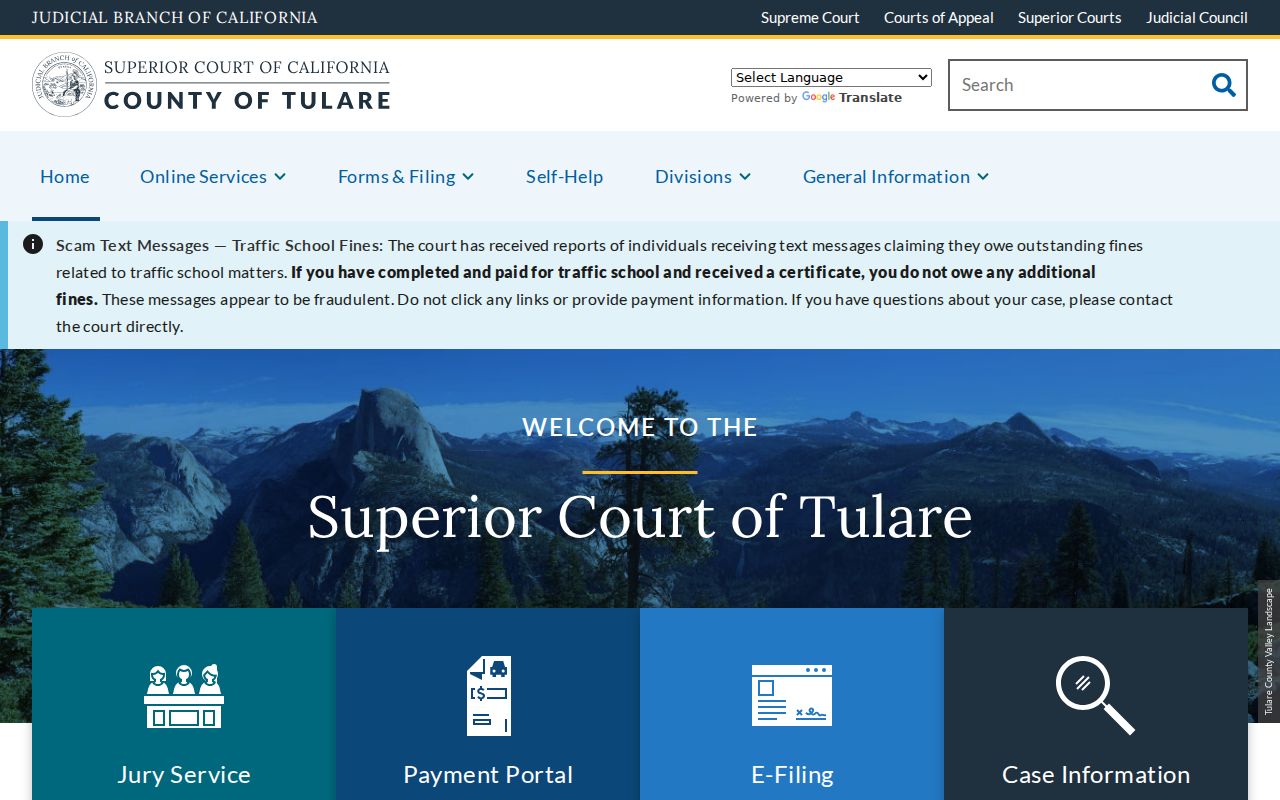
The court capture points to the official court domain, while copy requests still require the separate records workflow and the case number when available.
Tulare County Vital Copy Choices
The Tulare County Clerk-Recorder issues county birth, death, and marriage certificates, while the California Department of Public Health Vital Records program holds statewide copies and ordering guidance. California separates authorized certified copies from informational certified copies. An authorized copy can establish identity for an eligible requester who completes the statutory process. An informational copy is marked as not valid to establish identity, even when it carries certificate information useful for genealogy or personal research. The California Vital Records route explains the state and county split.
Authorized applicants can include the registrant, close relatives, a legal guardian, an eligible government or law-enforcement representative, a court-authorized party, an attorney for the registrant or estate, and specified funeral or estate representatives. Mail requests require the application’s sworn statement to be notarized when an authorized copy is requested. CDPH does not offer a direct electronic request portal and sends orders by First Class Mail. Confidential marriages are restricted under Family Code §509, and adoption or confidential birth material remains sealed unless statutory or court authority applies.
Effective January 1, 2026, CDPH lists fees of $31 for birth, $26 for death, $19 for marriage, $18 for a dissolution certificate, $23 for fetal death, and $28 for stillbirth. AB 64 also permits specified diacritical marks on newer vital records, so an older search should try marked and unmarked forms. A failed search retains the fee and returns a Certificate of No Public Record. CDPH marriage holdings are stated as public marriages from 1905 to 1999 and 2008 to 2023, so gap years and current events should go to the county Clerk-Recorder. Divorce pleadings remain with Superior Court; CDPH supplies only its limited certificate or record.
Note: County and state certificate offices use the same event categories but different custody, eligibility, and copy rules, so the requested copy type should be named first.
Tulare County CPRA Requests
The California Public Records Act, Government Code §§7920.000-7931.000, is a focused fallback when an existing county record is not exposed by a search page. Tulare County routes requests through the Clerk of the Board’s NextRequest public-records channel. The Clerk of the Board is at 2800 W. Burrel Ave., Visalia. Counter hours are Monday through Thursday from 7:30 a.m. to 5:30 p.m. and Friday from 8 a.m. to noon. A requester may remain anonymous if useful contact information is supplied for the response.
Ask for an existing, identifiable record, such as permits for a named address and date range, a stated document type, or a particular administrative file. The county does not have to create a new resident list, compilation, or index in response to a broad question. Electronic delivery is free. Letter-size paper is 50 cents for the first page and 10 cents for each additional page; media is charged at actual cost. Agencies normally make an initial determination within 10 calendar days under Government Code §7922.535, with an unusual-circumstances extension of up to 14 days by written notice. Determination is not the same as production.
A narrow request gives staff a record type, office, address, APN, date span, and preferred format. If the record is held by a city, the city clerk or responsible records unit is the proper first custodian. For deeds, the Recorder’s mail or counter route is more direct. For a court file, use the court request process. CPRA is valuable when an agency has an existing record, not as a way to make one office combine every resident clue.
The Tulare County NextRequest page is represented by the manifest capture.
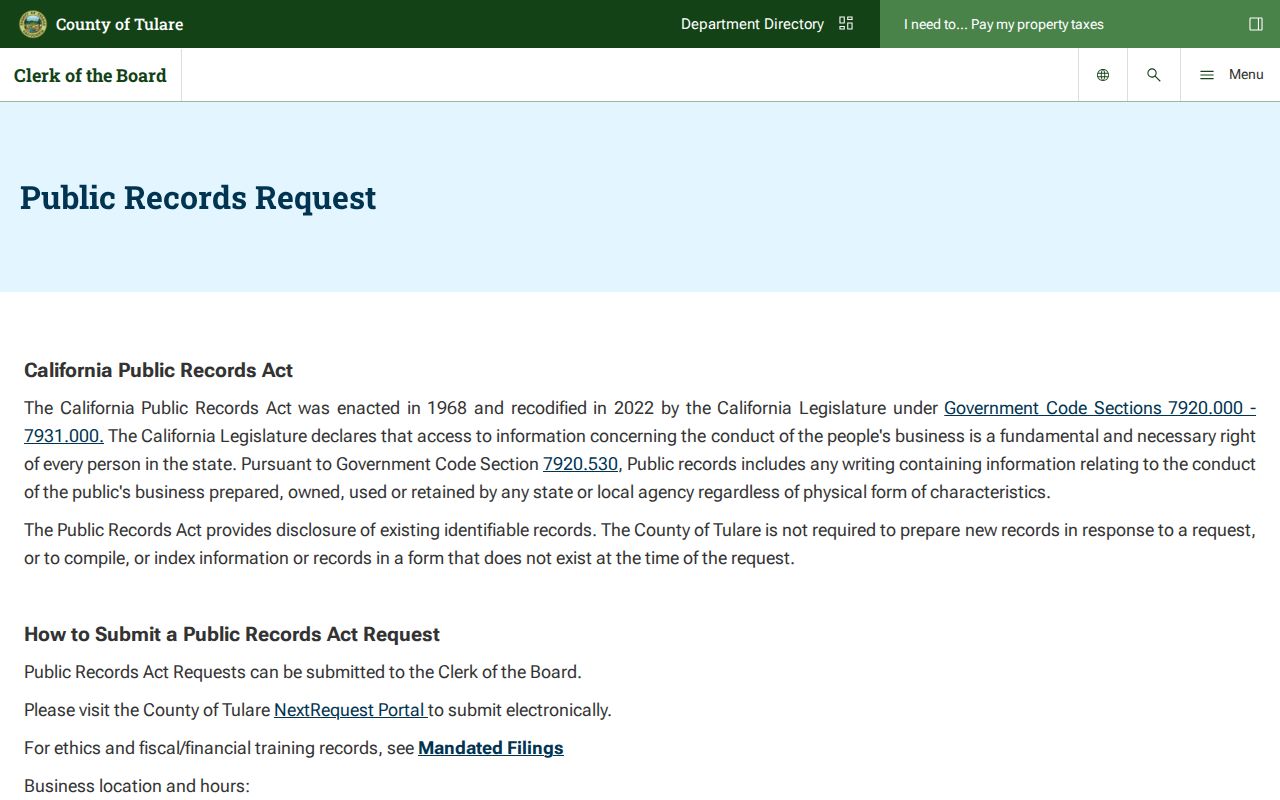
The capture is a lead to the county’s public-records route; the actual request should still identify the existing record and likely custodian.
Historical Tulare County Residents Directory Shelves
Historical residents directory work is centered on the Annie R. Mitchell History Room, not a single countywide online file. City and telephone directories, reverse or criss-cross volumes, newspapers, yearbooks, maps, and local manuscripts can put a person at a place during a particular period. A printed directory is a snapshot of canvassed or supplied information. It can show a listed household connection without proving ownership or continuous residence.
The full collection strategy belongs on the Tulare County city directory collections page. For a countywide search, the key point is that no authoritative public shelf list naming every publisher and year run was found. Ask the History Room for the exact Visalia, Tulare, Porterville, or community volume and year before assuming a gap means no directory existed. Pair an address section with a name section when the old street number is known.
Historical continuity also comes from Great Registers, census schedules, cemetery records, and newspapers. The federal census is public through 1950 under the national 72-year release rule. The 1890 population schedules were largely destroyed, so local directories, Great Registers, deeds, and newspaper notices can bridge that missing snapshot. Modern sources should not be silently blended with old household entries.
Note: An old directory entry supports a place-and-time connection, while a deed supports a recorded land transaction; they answer different questions.
Annie R. Mitchell History Route
The Annie R. Mitchell History Room at the Visalia Branch, 200 W. Oak Ave., Visalia, is Tulare County’s local-history gateway. It is open Tuesday through Friday from 1 to 5 p.m. and can be reached at 559-713-2727. Researchers can visit, email, or submit the library’s research-request form. Staff asks for precise names, dates, places, and the question being asked. Research is performed as staffing permits and may take days to weeks, so a short, well-defined request is more useful than a general request for every record about a family.
The room routes researchers to historical microfilm, school yearbooks, newspaper access, a Memory Lab, and the history of Tulare County and Visalia libraries. Newspapers may supply obituaries, weddings, legal notices, moves, and organization ties. Yearbooks can resolve classmates, school years, name variants, and photographs. Microfilm can reveal an address when a web index has no name field. A local photograph or manuscript may connect a person to a group or place, but it remains a historical source that should be paired with an official record when the fact matters.
The Annie R. Mitchell History Room page is the best place to confirm current contact options and ask which local volumes are available. The Visalia Public Cemetery collection covers 1875 to 1990 and contains 55,596 searchable records, with name, date, grave, mortuary, and related biographical fields. The Visalia Cemetery record collection is useful for distinguishing people with the same name, but burial proves interment, not residence. The California State Library, State Archives, NARA, FamilySearch catalogs, church archives, and school collections are useful secondary routes when the local shelf does not hold the needed year.
Great Registers and Tulare Residents
Selected Tulare County Great Registers survive for 1869, 1872, 1879-1880, 1882, 1884, 1886, 1888, 1890, 1892, 1894, and 1896. The catalog describes registers filmed from California State Library material and alphabetized by the first letter of surname. These historical voter rolls provide named residence evidence in many gaps between federal census snapshots. They are not current voter data and should be treated as historical records for genealogy, local history, and identity research.
An entry may include a name, age, nativity, occupation, residence or precinct, and naturalization detail, depending on the year. Search the surname letter, then compare residence, occupation, age, and related names with a directory, deed, newspaper, or cemetery record. The Tulare County Great Registers catalog identifies the surviving years and any account or affiliate-access conditions for images.
Four terms help keep the records in their lane:
- Roll
- A defined set of entries, such as a voter or assessment roll, created for a stated public purpose. It is not a complete list of every resident.
- Index
- A finding aid that points to a record by name, number, type, or date. The filed image or certified copy may contain more detail.
- Criss-cross directory
- A reverse directory that starts with a street and number, then gives the listed occupant, telephone, or household clue for that edition.
- Parcel
- A distinct land unit identified by an APN and legal description. A parcel’s assessed owner is not automatically every occupant.
Note: Great Registers are strongest when used as dated historical snapshots and weakest when treated as proof of a person’s present address.
Tulare County Business License Clues
Public business and professional records can confirm an organization or public work connection without pretending they are household rolls. California Secretary of State bizfile Online Business Search accepts an entity name or number. Keyword and Exact modes are not case-sensitive. Punctuation is normalized in keyword mode, spacing matters, and keywords longer than 12 characters are truncated. Results and downloadable filings can show status, jurisdiction, agent, address, and statements of information. A Tulare County Fictitious Business Name filing can connect a trade name to a registrant, but it is not a professional license.
The California Department of Consumer Affairs license search and individual state boards can show a public license number, status, issue or expiration date, and discipline when available. A license address is a business or mailing address unless the record says otherwise. The State Controller’s free unclaimed-property search is another narrow clue: Last or Business Name or Property ID is required, while First Name, City, and ZIP are optional. It returns exact matches first and similar names after that. Such a result is a last-known-place lead, not proof of current residence.
| Source type | Useful strength | Boundary |
|---|---|---|
| Official county or state record | Named custodian, stated fields, traceable filing | May be old, limited, redacted, or purpose-controlled |
| Historical collection | Dated household, organization, address, or event clue | Coverage and transcription vary by year |
| Commercial people-finder category | May surface a lead across purchased or compiled data | Stale, merged, costly, and not a custodian record |
Official sources are better for checking a defined fact because their keeper, search fields, and record limits are visible. A commercial compilation can be a lead at most, and it must not override a protected address or a custodian’s correction. Use the source that matches the question and keep the original record date.
The manifest capture shows the bizfile search entry point.
The business search image illustrates the entity route, where filings and entity status matter more than a private residence assumption.
Business and license records are especially useful in an agricultural county where land, packing, food, construction, and health services may be held through entities or public licenses. Combine a business clue with an official parcel, court, or FBN record only when the purpose is lawful and the connection is clear.
The manifest capture from the California Department of Consumer Affairs license search shows the state regulatory entry point.
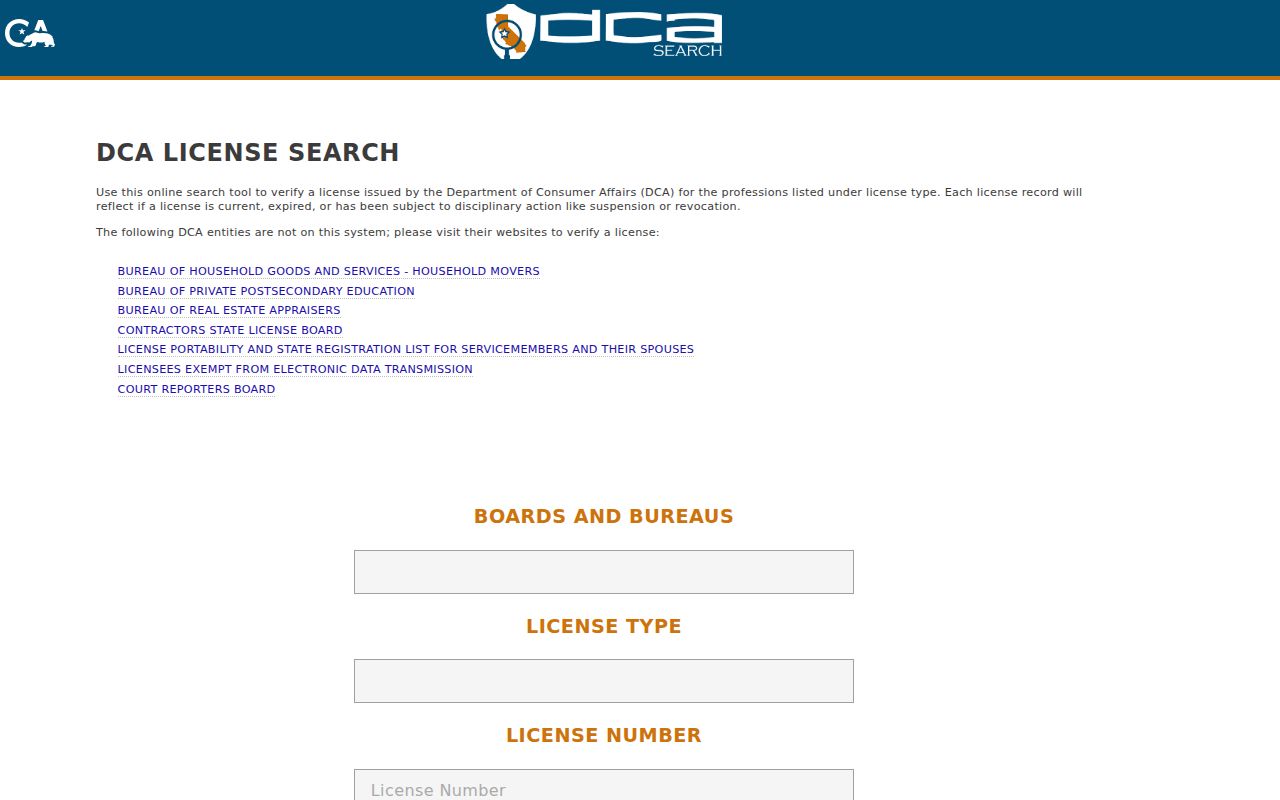
The license search image points to the state regulatory route and does not turn a business address into a home address.
For a custody question, use the responsible official custody or registry channel. Those focused records can change, omit protected categories, or describe custody and registration without proving a Tulare County residence.
Protected Tulare County Addresses
Public access has limits where disclosure can create harm. California’s Safe at Home program gives qualified survivors and other protected participants a substitute mailing address and supports confidential voter registration. The California Secretary of State Safe at Home program should control any question about eligibility or protected-address handling. A public record search must never be used to reverse a substitute address. Voter-file requests remain subject to Elections Code §2194, and voter misuse can also implicate Elections Code §18109.
DMV motor-vehicle information is restricted by the Driver’s Privacy Protection Act and state law. Utility customer lists are not an open resident directory. Juvenile, adoption, sealed, confidential-marriage, and protected court material are not ordinary public results. California privacy rights under Civil Code §1798.100 and the Delete Act’s data-broker process can help with covered commercial data, but they do not erase the county’s original public record merely because a downstream compilation changes.
Lawful personal use. Tulare County public records may support personal, family-history, reunification, safety, or civic research. Do not use an address, name, voter clue, court result, or commercial compilation to stalk, harass, threaten, intimidate, or harm another person.
Note: A protected address can be absent, substituted, redacted, or handled through a different access rule; absence is not evidence of a move.
Tulare County Resident Records Scam Checks
Record searches attract payment scams because a familiar office name can make a message seem official. The Recorder’s published schedule lists $3 for the first page of an ordinary official record and $1 for each added page, so a deed-copy solicitation demanding far more should be checked with the Recorder at 559-636-5050. Property-fraud alert notices should be matched to the county’s own Assessor and Clerk-Recorder hub. California’s unclaimed-property search is free, so an upfront payment demand is a warning sign.
In 2026, Tulare Superior Court warned about fraudulent traffic-school fine text messages. Do not click the payment link or provide information from the text. Open the official court domain directly, confirm the case or fine through the court, and report a loss or threat to the proper law-enforcement agency. A newspaper notice, business message, or caller ID is not a substitute for the custodian’s official contact route.
Keep the original URL, date, record number, receipt, and request language when reporting a problem. Use the Recorder for a deed-copy concern, the Superior Court for a court message, the Clerk of the Board for a county records request, and the relevant city or state office for a municipal or license issue. A focused, dated trail protects the searcher and makes the next verification step easier.